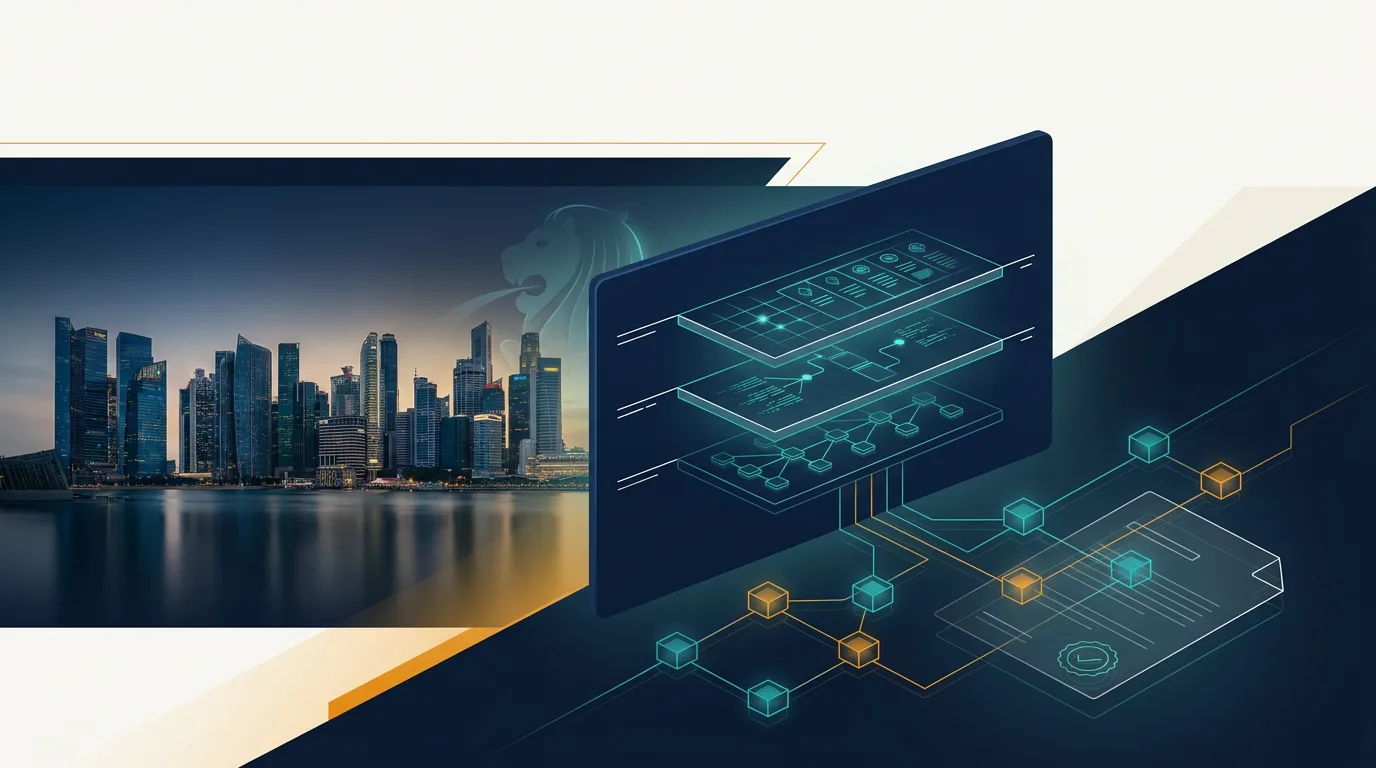
Crypto trading is legal in Singapore under MAS's layered framework. Understand the PSA, FSMA, SFA rules, retail restrictions, and licensing obligations for operators.
Cryptocurrency is legal in Singapore. That is the short answer. The fuller answer is that Singapore operates one of the most structured digital asset frameworks in the world, and whether you are a retail investor, an institutional player, or a business seeking to operate here, different rules apply to you.
The Monetary Authority of Singapore (MAS) regulates crypto primarily through three pieces of legislation: the Payment Services Act (PSA), the Securities and Futures Act (SFA), and the Financial Services and Markets Act (FSMA). Each targets a different slice of the ecosystem. Navigating them correctly is not optional — enforcement is real, penalties are significant, and MAS has made clear it expects full compliance.
This article breaks down the legal architecture in practical terms: what the law says, who it applies to, and what it means for retail traders, accredited investors, and businesses seeking to operate in Singapore’s digital asset market.
Legal Status of Crypto in Singapore
Cryptocurrency is fully legal in Singapore. Buying, holding, and selling digital assets is permitted for individuals and institutions alike. Owning crypto is unrestricted. Individuals and institutions can buy, hold, and sell digital assets through licensed platforms, subject to the consumer-protection rules that apply at the retail level.
That said, crypto is not legal tender. The Singapore Dollar (SGD) is the only legally recognised currency for settling debts. A merchant has no obligation to accept Bitcoin or any other digital asset as payment, though nothing prevents one from choosing to do so.
MAS classifies most cryptocurrencies as Digital Payment Tokens (DPTs) — digital representations of value that are not pegged to any fiat currency and are intended as a medium of exchange. Bitcoin and Ether are DPTs. This classification determines which laws apply, what a business must do to operate legally, and what protections consumers are entitled to.
The Regulatory Framework: PSA, SFA, and FSMA
Singapore does not rely on a single crypto law. Instead, MAS applies a layered framework where the applicable legislation depends on the nature of the asset and the type of activity involved.
Payment Services Act (PSA)
The PSA came into force on 28 January 2020 and forms the foundation of crypto regulation for businesses. It created a licensing regime for DPT service providers — exchanges, custodians, OTC desks, and wallet operators that handle or facilitate the transfer of digital assets.
Under the PSA, two licence types exist for DPT services:
- Standard Payment Institution (SPI): For operators with monthly transaction volumes below SGD 3 million. Minimum base capital of SGD 100,000. Lighter compliance obligations.
- Major Payment Institution (MPI): For operators exceeding the SGD 3 million monthly threshold. Minimum base capital of SGD 250,000. Mandatory annual audits, full AML/CFT compliance, and direct MAS supervision.
An operator that starts as an SPI and crosses the volume threshold is legally required to upgrade to an MPI licence. There is no discretion here.
Securities and Futures Act (SFA)
Not every token falls under the PSA. If a digital asset constitutes a capital markets product — a security, a debt instrument, or a unit in a collective investment scheme — the SFA governs instead.
MAS does not classify tokens by name or marketing label. It assesses the token’s features and the rights it confers on holders. A governance token that entitles holders to a share of profits is likely a security. A token backed by real-world assets may qualify as a capital markets product. Any platform dealing in such tokens must hold a Capital Markets Services (CMS) licence. Conducting an unlicensed securities offering is a criminal offence.
Financial Services and Markets Act (FSMA)
The FSMA was passed in April 2022, and its Part 9 — governing Digital Token Service Providers (DTSPs) — came into force on 30 June 2025. This addressed a specific gap: before the FSMA, Singapore-incorporated entities serving only overseas clients could argue they fell outside MAS’s licensing scope.
That argument is no longer available. From 30 June 2025, any Singapore-based entity providing digital token services — whether to local or overseas customers — must hold the appropriate MAS licence or cease operations.
Critically, MAS has explicitly stated it will generally not issue DTSP licences to entities serving only overseas clients. The regulator’s position is that such business models present higher money laundering and terrorism financing risks, and that MAS has limited supervisory reach over the underlying client relationships. Businesses structured around Singapore-domiciled operations with overseas-only clients are expected to exit Singapore or restructure.
For a detailed breakdown of the available licensing pathways, see GSS Legal’s Crypto & VASP Licensing services.
Token Classification: What Type of Asset Are You Dealing With?
Before any compliance analysis, a Singapore operator or investor needs to know what type of digital asset they are dealing with. The applicable regulatory regime flows from this classification.
| Token Type | Examples | Applicable Law | Licence Required |
|---|---|---|---|
| Digital Payment Token (DPT) | BTC, ETH, SOL | PSA | SPI or MPI |
| Capital Markets Product Token | Security tokens, tokenised funds | SFA | CMS Licence |
| Single-Currency Stablecoin (SCS) | SGD-pegged or G10-pegged stablecoins | PSA (SCS Framework) | MPI |
| Utility Token | Platform access tokens | Generally outside PSA/SFA | Fact-specific analysis required |
MAS assesses substance over form. A token labelled a “utility token” that also confers profit-sharing rights may still be classified as a capital markets product. Getting this classification right at the outset is fundamental — misclassification exposes operators to criminal liability. Our Jurisdiction Advisory service includes this token classification analysis as part of the pre-application process.
Rules for Retail Investors
Individual retail investors in Singapore can legally buy, hold, and sell digital assets through MAS-licensed platforms. There are no restrictions on which DPTs they can trade or how much they can hold. However, MAS has introduced a set of consumer protection measures that all licensed DPT service providers must enforce at the retail level.
These measures, phased in through 2024 and 2025, include:
- Mandatory risk awareness assessment: Retail customers must pass a knowledge test before accessing DPT trading services on any licensed platform. The test assesses whether the customer understands the risks of digital asset trading.
- No credit facilities or leverage: Licensed operators cannot provide loans, credit, or any leveraged product to retail customers for the purpose of purchasing or holding DPTs. Use of domestic credit cards to buy crypto is also prohibited.
- No incentives or promotions: Platforms cannot offer monetary or non-monetary incentives — referral bonuses, airdrops, sign-up rewards — to encourage retail customers to trade DPTs.
- No lending or staking of retail assets: Licensed operators are prohibited from lending or staking crypto assets held on behalf of retail customers. This rule was directly informed by the Celsius and FTX collapses.
- Prominent risk disclosures: Platforms must display clear, prominent warnings about the speculative nature and volatility of DPTs. Advertising that trivialises risk is prohibited.
These restrictions apply to locally licensed operators. Foreign platforms accessing Singapore retail customers without a valid MAS licence are in breach of the law, regardless of where the platform is hosted.
Rules for Institutional and Accredited Investors
Singapore draws a clear legal distinction between retail customers and two higher-tier investor categories: Accredited Investors (AIs) and Institutional Investors (IIs). Each tier has access to a broader range of products and is subject to fewer protective restrictions.
An Accredited Investor is broadly defined as an individual with net personal assets exceeding SGD 2 million, or financial assets exceeding SGD 1 million, or annual income of at least SGD 300,000. For net personal asset calculations, DPT holdings are subject to a minimum 50% downward valuation, capped at SGD 200,000. Institutional Investors include banks, insurers, licensed fund managers, and similar regulated entities.
The key practical differences for AIs and IIs operating in the DPT space are:
- Crypto lending and staking through intermediaries remains available to AIs and IIs, with explicit disclosure and consent requirements.
- AIs and IIs are not subject to the retail risk awareness assessment requirement.
- Certain products and structures available to AIs and IIs — such as token-based structured notes — may be off-limits to retail customers under the SFA.
- AIs and IIs can opt into reduced regulatory protections, but must do so affirmatively in writing.
The distinction matters operationally. A licensed DPT service provider must classify every customer correctly and apply the corresponding compliance obligations. Misclassifying a retail customer as an accredited investor — even unintentionally — exposes the operator to regulatory action.
Licensing Obligations for Crypto Operators
Any business providing DPT services from Singapore — exchanges, custodians, OTC desks, wallet operators, stablecoin issuers, or platforms serving either local or overseas clients — must hold a valid MAS licence before commencing operations.
The core licensing requirements under the PSA and FSMA include:
- Base capital: SGD 100,000 for Standard Payment Institutions; SGD 250,000 for Major Payment Institutions and DTSP applicants.
- Fit and proper: Directors, shareholders, and senior managers must meet MAS’s fit and proper criteria.
- Singapore-resident compliance officer: A qualified compliance officer physically based in Singapore is mandatory.
- AML/CFT programme: A documented programme aligned with MAS Notice PSN02, covering customer due diligence, transaction monitoring, and suspicious transaction reporting.
- Technology risk management: Compliance with MAS’s Technology Risk Management (TRM) Guidelines, including penetration testing, incident response procedures, and board-level oversight.
- Customer asset segregation: Client funds must be held in trust and segregated from company assets. At least 90% of customer crypto assets should be held in cold storage.
- Annual audits: Mandatory for MPI licence holders; not required for SPIs but subject to MAS review.
Operators already holding a licence under the PSA or SFA for a given service are generally not required to obtain a separate DTSP licence under the FSMA for that same service. However, any activity not covered by existing licensing may bring the FSMA into scope. The boundaries require careful analysis.
For businesses assessing their licensing pathway, GSS Legal’s VASP Licence and AML & Compliance services cover the full application and ongoing compliance requirements.
AML/CFT and Ongoing Compliance Requirements
AML/CFT compliance is not a one-time exercise in Singapore. MAS actively supervises licensed operators and has imposed fines and revoked licences for failures in this area.
The core ongoing obligations for licensed DPT service providers are:
- Customer Due Diligence (CDD): Identity verification for all customers before onboarding. Includes name, date of birth, identification document, address, and documented purpose of the business relationship.
- Enhanced Due Diligence (EDD): Required for high-risk customers, politically exposed persons (PEPs), customers from high-risk jurisdictions, and high-value accounts. Includes source-of-funds verification and senior management approval.
- Ongoing transaction monitoring: Automated and manual review of customer transaction patterns for suspicious activity.
- Suspicious Transaction Reports (STRs): Filed with the Suspicious Transaction Reporting Office (STRO) under the Corruption, Drug Trafficking and Other Serious Crimes (CDSA) Act when suspicious activity is identified.
- FATF Travel Rule: For any virtual asset transfer exceeding SGD 1,500, the originating institution must transmit the sender’s name, account number, and address — together with the recipient’s name and account number — to the receiving institution before the transfer is processed.
The Travel Rule has direct operational implications for exchanges processing outbound transfers to self-custodial wallets. Licensed platforms must collect and verify counterparty information before processing qualifying transactions — and cannot rely on the customer’s self-declaration alone.
Stablecoin Regulation
Singapore has developed one of the most detailed stablecoin frameworks globally. MAS finalised its Single-Currency Stablecoin (SCS) Framework in August 2023, targeting stablecoins pegged to the Singapore Dollar or any G10 currency and issued in Singapore.
Under the framework, issuers of qualifying SCS must:
- Hold 100% reserve backing in high-quality, liquid, same-currency assets.
- Segregate reserve assets with approved custodians.
- Redeem stablecoins at par value within five business days.
- Hold an MPI licence and apply for the formal “MAS-regulated stablecoin” designation.
- Meet minimum base capital requirements and adhere to applicable AML/CFT obligations.
Only stablecoins that fulfil all framework requirements can carry the “MAS-regulated stablecoin” label. This designation serves a practical purpose: it allows users and counterparties to distinguish fully compliant, reserve-backed instruments from other tokens that market themselves as stablecoins but operate outside the framework.
Stablecoins pegged to currencies or assets outside the SCS Framework’s scope — or issued from outside Singapore — remain subject to standard DPT rules under the PSA. Retail customers cannot engage in lending or staking of SCS through licensed intermediaries; these activities remain available only to AIs and IIs with appropriate disclosures.
Legislative amendments to formally enshrine the SCS Framework in statute were in progress as of mid-2026, with MAS working toward a public consultation on the final implementation details.
Tax Treatment of Crypto in Singapore
Singapore imposes no capital gains tax on any asset class, and that includes digital assets. An investor who buys BTC at SGD 40,000 and sells at SGD 120,000 owes nothing on the SGD 80,000 gain — provided the activity qualifies as investment rather than business trading.
The Inland Revenue Authority of Singapore (IRAS) distinguishes between investment activity (not taxable) and trading as a business (taxable). The factors it considers include transaction frequency, the systematic or professional nature of the activity, and whether profit from trading is the investor’s primary income source. There is no bright-line rule; IRAS assesses each situation on its facts.
The following table summarises the tax treatment of common crypto activities:
| Activity | Classification | Taxable? | Rate |
|---|---|---|---|
| Long-term holding (investor) | Capital gain | No | 0% |
| Frequent trading as a business | Business income | Yes | Up to 22% (individual) / 17% (corporate) |
| Staking rewards | Income on receipt | Yes | Standard income tax rates |
| Commercial mining | Business income | Yes | 17% on net profit (corporate) |
Staking rewards are treated as ordinary income at the point of receipt, valued at the SGD market price of the tokens on the date received. Any subsequent appreciation of those staked tokens after receipt is treated as a capital gain — and therefore not taxable for individual investors. For businesses operating staking services or yield products, corporate income tax at 17% applies to net profits.
Complex DeFi activities — liquidity pool positions, cross-chain yield strategies — remain an area where IRAS guidance is still developing. Operators and investors in these spaces should obtain specific tax advice.
Enforcement and Penalties
MAS enforces Singapore’s digital asset rules actively. The penalties for non-compliance are significant and extend to both civil and criminal liability.
- Operating a DPT service without a valid MAS licence carries fines of up to SGD 250,000 and imprisonment of up to three years.
- Breaching AML/CFT obligations — including Travel Rule failures — can result in licence revocation and substantial financial penalties.
- Unlicensed entities that failed to exit Singapore by the 30 June 2025 FSMA deadline were directed to cease operations immediately.
- MAS maintains a public Investor Alert List naming entities operating without authorisation or flagged for investor risk. Firms on this list are considered to be operating in breach.
MAS has revoked licences where operators have failed to maintain required standards after licensing. Holding a licence is the starting point, not the end point. Ongoing compliance — updated AML programmes, renewed technology risk assessments, accurate customer classifications — is what maintains the licence in good standing.
For businesses at the pre-application stage, reviewing enforcement history and understanding what MAS expects post-licensing is a standard part of any credible advisory process. GSS Legal’s AML & Compliance practice covers both pre-application programme design and post-licensing regulatory stewardship. For jurisdiction-level questions — whether Singapore is the right base for your particular business model — see our Jurisdiction Advisory service.
Key Takeaways
Singapore’s approach to crypto is not hostile — it is structured. The framework creates real compliance requirements, but it also creates a stable, credible environment that institutional capital and serious operators can work within.
The practical summary by category:
- Retail investors can freely trade DPTs through licensed platforms. They must pass a risk awareness assessment, cannot use credit or leverage, and cannot access lending or staking products through intermediaries.
- Accredited and institutional investors face fewer restrictions, with access to a broader product range — including lending, staking, and structured token products — subject to explicit disclosures and consent.
- Crypto operators must hold the appropriate MAS licence before commencing any DPT services. The choice of licence — SPI, MPI, or a specific DTSP pathway — depends on business model, transaction volumes, and client base. Entities serving only overseas clients from Singapore should expect MAS to deny a DTSP licence and plan accordingly.
- Stablecoin issuers targeting the SGD or G10 currency peg market must comply with the SCS Framework and hold an MPI licence to carry the “MAS-regulated stablecoin” label.
- Tax remains favourable for investors: no capital gains tax on DPT holdings. Business trading and staking income are taxable at standard rates.
The regulatory landscape will continue to evolve. MAS has signalled ongoing attention to DeFi, stablecoin legislation, and tokenised asset frameworks. Businesses already operating in Singapore — or considering it — should track these developments as a core operational function, not a periodic check.
Considering a Crypto Licence in Singapore?
GSS Legal advises on MAS licensing across the full digital asset stack — from initial token classification and licence selection through AML programme design, application submission, and post-licensing compliance. With a Singapore desk and a track record of 800+ licences across 50+ jurisdictions, we work with exchanges, custodians, stablecoin issuers, and VASP operators at every stage of the process.
If you are evaluating Singapore — or comparing it against other jurisdictions — our Jurisdiction Advisory service is the right starting point. For businesses ready to proceed, our Crypto & VASP Licensing practice handles the end-to-end process.