
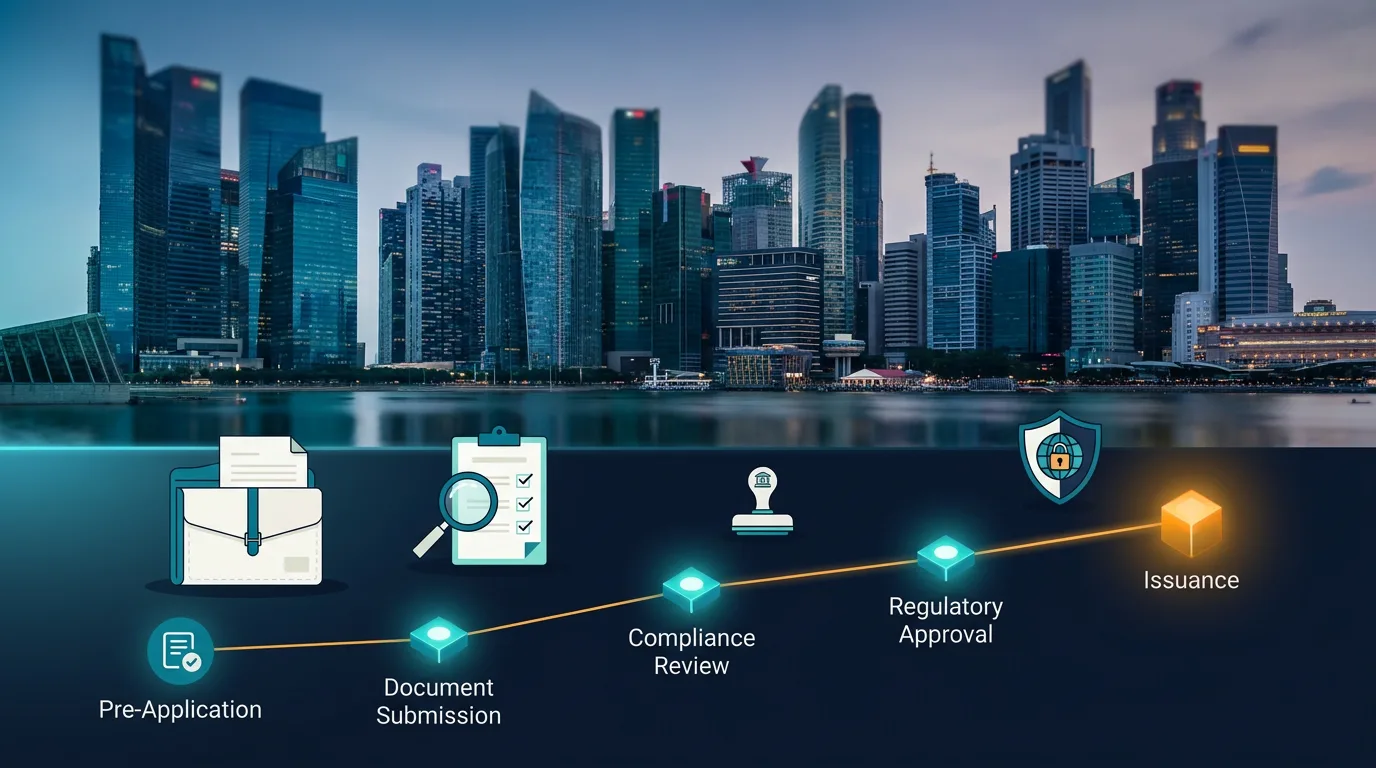
A practical step-by-step guide to obtaining a MAS Major Payment Institution (MPI) licence in Singapore, covering eligibility, documents, AML/CFT, and post-approval obligations.
The Monetary Authority of Singapore (MAS) Major Payment Institution (MPI) licence sits at the top tier of the Payment Services Act 2019 (PSA) framework. It is the licence required by any payment service provider that exceeds volume thresholds set for Standard Payment Institutions, or that wants to operate without those caps from the outset.
Since MAS revised its Guidelines on Licensing for Payment Service Providers (PS-G01) in July 2024, with a further update effective October 2025, the application has become more demanding. All new applicants must now submit an independent legal opinion alongside their application pack. Those seeking to provide Digital Payment Token (DPT) services face an additional external auditor assessment. These are not optional documents — they are formal submission requirements.
This guide walks through every stage of the MPI licence process in sequence: from the initial scoping decision, through entity setup, document preparation, submission, MAS review, and through to post-approval compliance obligations. It is written for founders, compliance officers, and legal counsel who need to understand not just what is required, but when and why.
What Is an MPI Licence and Who Needs One?
A Major Payment Institution is a payment service provider licensed by MAS under the PSA to conduct one or more regulated payment services without being subject to the transaction volume caps that apply to Standard Payment Institutions. The MPI licence is activity-based: MAS licenses specific services, not businesses in the abstract.
Under the PSA, there are seven regulated payment service categories. An MPI may be licensed for one or more of the following:
- Account issuance service
- Domestic money transfer service
- Cross-border money transfer service
- Merchant acquisition service
- E-money issuance service
- Digital payment token (DPT) service
- Money-changing service
Each activity you intend to conduct must be designated within your MPI application. You cannot simply apply for a generic MPI licence — MAS assesses your business model against each specific service category you propose to operate.
SPI vs. MPI: How the Thresholds Work
The PSA creates two licence tiers for payment service providers above the money-changing exemption. The Standard Payment Institution (SPI) operates within statutory volume caps. The MPI operates without those caps, but carries higher capital, audit, and safeguarding requirements in return.
Per the MAS licensing page, an MPI licence is needed when your services exceed any of the following SPI thresholds:
| Threshold Trigger | Value |
|---|---|
| Monthly transactions — any single regulated payment service (excluding e-money issuance and money-changing) | SGD 3 million |
| Monthly transactions — two or more regulated payment services (same exclusions) | SGD 6 million |
| Daily outstanding e-money | SGD 5 million |
There is a practical planning point here. If your projected volumes will breach any SPI threshold within 18 to 24 months of launch, applying for an MPI from the start is almost always more efficient than obtaining an SPI and then seeking a licence variation. The variation process takes time and cost that a well-planned MPI application avoids.
The key financial differences between the two licence types are summarised below:
| Requirement | SPI | MPI |
|---|---|---|
| Minimum base capital | SGD 100,000 | SGD 250,000 |
| Security deposit (cash or bank guarantee with MAS) | Not required | SGD 100,000 – SGD 200,000, depending on projected monthly volume |
| User fund safeguarding (segregated accounts, daily reconciliation) | Not required at SPI scale | Required |
| Annual external auditor report (PS Act compliance + safeguarding) | Not required at SPI level | Required |
| MAS review timeline (complete application) | 4–6 months | 12+ months |
Step 1 – Regulatory Scoping and Entity Setup
Before preparing any documents, the first task is a clear regulatory scoping exercise. You need to identify every payment service you intend to provide and confirm that each falls within the PSA’s regulated categories. This matters because the services you designate in your MPI application define your licence scope — adding a new service later requires a separate variation application.
On entity structure, MAS requires applicants to be a Singapore-incorporated company or a Singapore branch of a foreign corporation registered under the Companies Act. The entity must exist and be registered with ACRA at the point of application. MAS will not process an application for an entity that has not yet been incorporated.
If you are considering whether to use an existing Singapore entity or to establish a new purpose-built vehicle, that decision should be made at this stage. Structural issues discovered after application preparation has begun create delays and may require restarting parts of the document pack. For assistance with Singapore entity formation as part of a broader licensing strategy, GSS Legal’s corporate formation and jurisdiction advisory services address exactly this stage of planning.
Step 2 – Pre-Application Preparation
Pre-application preparation is consistently the longest phase of the MPI process. It cannot be compressed without increasing risk. This is the stage where most applications that later stall actually develop their problems — not at submission.
The following elements must be in place before you lodge your application:
- Board and senior management composition. At least one executive director who is a Singapore citizen or PR, or one EP executive director plus one citizen/PR director. MAS expects this individual to exercise genuine operational oversight, not to serve as a nominal local director.
- Compliance Officer and MLRO. Both roles must be named individuals with demonstrable qualifications and clear reporting lines to the board. These appointments must be confirmed before lodgement, not planned for post-approval.
- Base capital. The SGD 250,000 minimum base capital must be in place at the point of application. MAS also expects a capital buffer above this statutory floor, calibrated to the scale and projected losses of the business.
- Safeguarding arrangement. MPI applicants must demonstrate how customer funds will be safeguarded. Options include a trust account with a licensed financial institution, a bank guarantee, or a full undertaking from a safeguarding institution. MAS expects the draft arrangement to be documented in the application.
- Security deposit. Separate from base capital, MPIs must lodge a security deposit with MAS — either as a cash deposit or bank guarantee — ranging from SGD 100,000 to SGD 200,000 depending on the services licensed.
- Independent legal opinion. Since 26 August 2024, all new MPI applicants must submit a legal opinion from a law firm with experience in the PSA. The opinion must assess how the PSA applies to each proposed service or product in the applicant’s business model. This is a mandatory submission requirement, not optional supporting material.
- External auditor assessment (DPT applicants only). If your business model includes DPT services, you must additionally commission an independent external auditor to assess your AML/CFT policies and consumer protection controls before submission.
Step 3 – Building the Document Pack
The application pack must be complete and internally consistent before submission. MAS will not begin substantive review of a partial application. Submitting incomplete documentation does not start the review clock — it triggers queries that push the timeline further back.
The core documents required for an MPI application are as follows:
| Document | Key MAS Expectation |
|---|---|
| Business plan (3-year financial projections) | Clear service scope, target market, revenue model, and risk appetite. Generic projections without customer segment analysis are a common deficiency. |
| Ownership structure diagram (to ultimate beneficial owner level) | Must capture all intermediate holding entities. Incomplete UBO disclosure is a frequent trigger for follow-up queries. |
| Board and senior management CVs with fit-and-proper declarations | Must demonstrate relevant payment services experience. Declarations must be completed for each director, CEO, and substantial shareholder. |
| AML/CFT programme | Must be bespoke to the applicant’s services, customer base, and geographies. Off-the-shelf templates are regularly identified and returned. |
| IT security and business continuity plan (BCP) | Must include evidence of penetration testing. Untested BCPs are a common gap. |
| Corporate governance framework | Board committee terms of reference, compliance function mandate, outsourcing oversight policy. Must show independence of control functions from business lines. |
| Safeguarding arrangement details | Name of safeguarding institution, draft contract if available, and systems for meeting PSA Section 23 timelines. |
| Independent legal opinion (PS-G01, since August 2024) | Opinion from a PSA-experienced law firm assessing each proposed service or product against the PSA framework. |
| MAS prescribed specimen forms (via GoBusiness) | Application form, fit-and-proper declarations, organisational structure form, financial resources form. Available on the MAS licensing page and GoBusiness portal. |
The AML/CFT programme deserves particular attention. MAS expects to see an enterprise-wide risk assessment tailored to your specific services and customer base — not a generic template. The programme must cover CDD/KYC policies, transaction monitoring rules with documented thresholds, sanctions screening protocols, a suspicious transaction reporting workflow to STRO via the MLRO, staff training plans, and a schedule for independent review. For DPT businesses, blockchain analytics capabilities and travel rule compliance must also be documented. GSS Legal’s AML and compliance practice assists applicants in building bespoke programmes that hold up under MAS scrutiny.
Step 4 – Lodging the Application via GoBusiness
MPI licence applications are submitted through the GoBusiness portal. The application fee is SGD 1,500 (non-refundable) for an MPI. A separate annual licence fee applies at renewal. Under the Payment Services Regulations this is commonly SGD 10,000 per MPI activity.
Before submitting, run a completeness check across the entire document pack. Confirm that all specimen forms are fully populated, all supporting documents correspond to the information in the forms, and that the business plan and AML/CFT programme are internally consistent in their descriptions of the applicant’s proposed services and customer profile. A misalignment between documents — even a minor one — is a common trigger for MAS supplementary queries.
If the application includes DPT services, confirm that the external auditor assessment has been completed and is attached. MAS will not progress an MPI application for DPT services without it.
Step 5 – MAS Review and Supplementary Queries
Once a complete application is lodged, MAS begins its substantive review. For MPI applications, the typical review period runs 12 months or more, with no firm upper bound, from a complete submission. Where MAS raises multiple rounds of supplementary queries, the timeline can extend further.
Supplementary queries are part of the normal process, not a sign of imminent refusal. However, the speed and quality of your responses matter. Slow or incomplete answers reset the internal review timeline. Having the core members of your compliance and legal team available to respond promptly is a practical necessity during this phase.
The most frequent MAS queries at this stage concern:
- Clarification of the applicant’s risk appetite and target customer segments
- Additional detail on transaction monitoring rules, thresholds, and alert escalation procedures
- Evidence of local decision-making authority (MAS looks for substance, not a Singapore address with offshore control)
- Outsourcing arrangements — nature, jurisdiction of the service provider, contractual audit rights, and exit provisions
- Capital runway: whether financial projections demonstrate adequacy beyond the statutory SGD 250,000 floor
- Source of funds for the base capital contribution
Step 6 – Approval-in-Principle and Pre-Launch Conditions
MAS typically issues an approval-in-principle (AIP) before the final licence. The AIP confirms that MAS is satisfied with the application in substance, but attaches pre-conditions that must be met before the formal licence is granted.
Common pre-conditions at the AIP stage include confirming that the security deposit has been lodged with MAS, finalising the safeguarding arrangement with the designated financial institution, and evidencing that key personnel appointments (including the Compliance Officer and MLRO) are formally in place. Some applicants also receive conditions relating to technology infrastructure or BCP testing that must be completed before launch.
The AIP is not a licence. Operating payment services on the basis of an AIP alone — without the formal licence — is not permitted. MAS must confirm fulfilment of all pre-conditions before the licence is formally issued.
Step 7 – Licence Issuance and Ongoing Obligations
Once pre-conditions are met, MAS issues the formal MPI licence. This is the point at which the ongoing regulatory relationship begins in earnest. The licence is activity-specific — you may only conduct the payment services listed in your licence conditions.
Post-issuance obligations for MPI holders include:
- Periodic returns. Financial statements, transaction data, and capital-adequacy reports must be submitted to MAS on the schedule set in licence conditions. Base capital must be maintained above SGD 250,000 at all times, and any shortfall is a reportable supervisory event.
- Annual external audit. MPI holders must have an annual independent audit covering PSA compliance, safeguarding arrangements, AML/CFT controls, and technology risk management. The audit report must be submitted to MAS within four to five months after the financial year-end, along with management’s response to any findings.
- Daily safeguarding reconciliation. MAS requires daily reconciliation between user funds owed and funds held in segregated safeguarding accounts. These records must be available for MAS inspection at any time.
- Change notifications. Material changes to directors, CEO, substantial shareholders, outsourcing arrangements, business model, or licensed services must be notified to MAS — prior notification is expected where possible.
- Cyber hygiene compliance. Ongoing compliance with MAS Notice PSN06 on cyber hygiene is required. This includes maintaining appropriate technical and organisational safeguards for customer information.
- Inspection readiness. MAS may conduct on-site or thematic inspections at any time. Licence holders should maintain audit-ready records and documentation throughout the life of the licence.
For operators who also hold other regulated licences — or who are assessing whether to add forex, crypto, or payment services capabilities to an existing regulated structure — GSS Legal’s work across forex and FX licensing, VASP licensing, and banking and EMI/PSP setup covers the full spectrum of payment-adjacent regulatory requirements.
Common Reasons Applications Stall
MAS does not publish data on refused or withdrawn MPI applications, but practitioner experience points to a consistent set of problems that extend timelines or lead to adverse outcomes.
Nominal local governance. Appointing a Singapore-resident executive director who has no real authority over the licensed business is one of the most frequent issues MAS identifies. The regulator looks for genuine local oversight — documented decision trails, board meetings conducted in Singapore, local management with operational authority. A brass-plate office with offshore control will not satisfy MAS’s current expectations.
Generic AML/CFT documentation. Off-the-shelf AML/CFT programmes that are not tailored to the applicant’s specific services, customer segments, and geographic risk profile are consistently returned. MAS expects an enterprise-wide risk assessment that reflects the actual business — not a document that could apply to any payment company anywhere.
Incomplete technology and BCP controls. Applications that lack evidence of penetration testing or that include a BCP that has never been tested are common sources of MAS queries. Commission the IT security assessment and run at least one BCP drill before lodgement.
Thin capital narrative. Demonstrating that the SGD 250,000 base capital is in place is necessary but not sufficient. MAS also scrutinises the source of the capital and whether the financial projections show an adequate runway. Shareholder loans or capital committed but not yet paid up typically generate follow-up questions.
Beginning operations before the licence is in hand. Marketing payment services, signing customer contracts, or accepting funds before the formal licence is issued is not permitted — even if an AIP has been received. This point is worth stating clearly because it has caught operators who misread the AIP as authorisation to operate.
Frequently Asked Questions
Can a foreign company apply for an MPI licence without incorporating in Singapore?
No. MAS requires applicants to be either a Singapore-incorporated company or a foreign corporation that has registered a Singapore branch under the Companies Act. A foreign entity without a Singapore registration cannot submit an MPI application. The Singapore branch or subsidiary must also maintain a permanent place of business in Singapore where books and records are held securely.
What is the difference between the security deposit and base capital?
These are two separate financial requirements. Base capital (SGD 250,000 minimum) is the applicant’s own equity, held within the business, and must be maintained on an ongoing basis. The security deposit (SGD 100,000 to SGD 200,000, depending on services) is lodged directly with MAS — either as a cash deposit or bank guarantee — and serves as a regulatory buffer. It is returned on cessation of the licence, subject to any outstanding obligations.
Is an MPI licence required specifically for crypto or DPT services?
Not automatically — but in practice, most serious DPT operators apply for an MPI from the outset because transaction volumes quickly exceed SPI thresholds. Any business buying, selling, transferring, or facilitating the exchange of digital payment tokens for customers in Singapore requires either an SPI or MPI licence under the PSA. DPT applicants must additionally submit an external auditor’s assessment of their AML/CFT and consumer protection controls as part of the application. See GSS Legal’s dedicated VASP licensing and VASP licence pages for more detail on the crypto-specific requirements.
How long does the full MPI application process take?
Pre-application preparation — building the document pack, appointing key personnel, commissioning the legal opinion, and arranging capital — typically takes two to four months for a well-resourced applicant. MAS’s substantive review of a complete MPI application generally runs 12 months or more, with no firm upper bound. The total end-to-end timeline from starting preparation to receiving the formal licence is therefore likely to be at least 14 months. Incomplete applications, slow responses to MAS queries, or material governance or compliance gaps will extend this timeline.
What is the application fee for an MPI licence?
The application fee is SGD 1,500, payable via the GoBusiness portal and non-refundable regardless of outcome. A separate flat annual licence fee of SGD 5,000 applies at each renewal. Advisory, legal opinion, and compliance build-out costs are separate; practitioner estimates for application and advisory work typically run from SGD 15,000 to SGD 40,000, with AML programme development and audit adding further cost.
Next Steps
The MAS MPI licence process is sequential and document-intensive. The most common cause of extended timelines is not a flawed business concept — it is an incomplete compliance framework, nominal local governance, or an AML/CFT programme that does not reflect the applicant’s actual risk profile. Addressing these at the pre-application stage, rather than in response to MAS queries, is what distinguishes applications that move through review efficiently from those that don’t.
GSS Legal operates from Singapore and Ho Chi Minh City and has guided clients through MAS licensing alongside payment, crypto, and forex regulatory work across more than 50 jurisdictions. Whether you are at the scoping stage, mid-preparation, or responding to MAS queries, the team can provide practical support across entity structure, AML/CFT programme build, legal opinion coordination, and ongoing compliance. Explore our full range of regulatory licensing services or review our success cases for context on how we work.
Speak with a Singapore Licensing Adviser
If you are preparing an MPI application or assessing whether an MPI or SPI is the right licence for your business model, book a consultation with the GSS Legal Singapore team. We provide practical, jurisdiction-specific advice from initial scoping through to post-approval compliance.

