
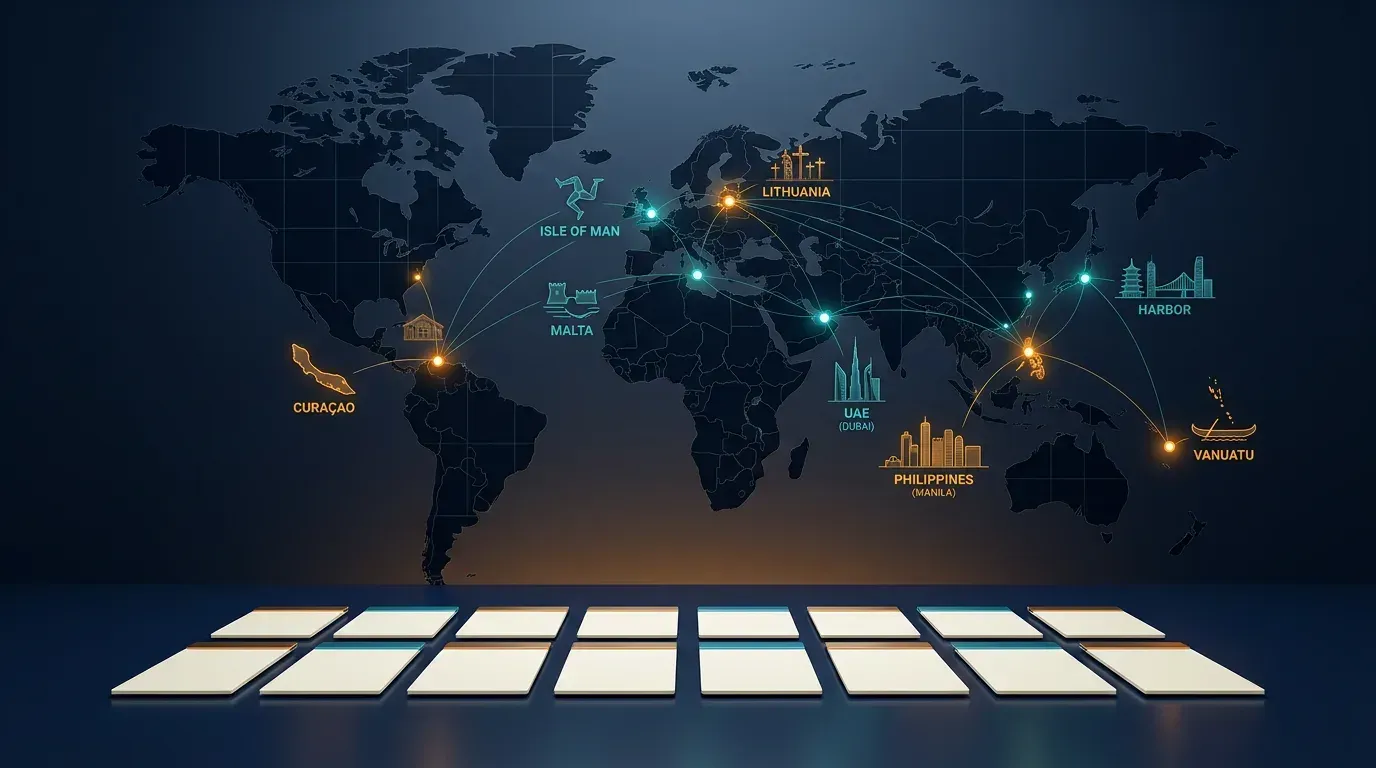
Choosing a licensing jurisdiction is a foundational decision for any iGaming project. The jurisdiction determines operating costs, access to banking and payment service providers (PSPs), the scope of player markets, and the level of legal compliance the operator must maintain long-term.
There are currently dozens of legal frameworks on the market that allow for iGaming licenses. However, not every license is suitable for every business model. A startup needing to launch quickly within six weeks will have a completely different choice compared to a platform with existing revenue targeting the EU market.
This article compares eight jurisdictions commonly used in the iGaming industry in 2026 — from low-cost offshore frameworks to European Tier 1 regulatory bodies — based on actual costs, processing times, compliance requirements, and suitable operator profiles. Information is updated according to policy changes in 2025–2026, including Curaçao's LOK reform and PAGCOR's Minimum Guaranteed Fee policy changes.
Evaluation Criteria for an iGaming Licensing Jurisdiction
Before comparing each specific jurisdiction, it is necessary to clearly define the evaluation dimensions. An iGaming license is not merely a legal document — it determines the entire operational infrastructure of the business.
Here are the six core criteria to consider:
- First-year all-in costs: Includes application fees, annual license fees, entity formation, technical audits, and legal advice — not just the listed fees of the regulatory body.
- Processing time: From application submission to receiving the official license.
- Reputation with banks and PSPs: Tier 1 jurisdictions like MGA or UKGC are accepted by most payment processors. Offshore jurisdictions can sometimes create barriers when establishing partnerships with PSPs.
- Market scope: Some licenses allow operators to serve customers globally; others are only valid within the domestic market.
- Compliance burden: The complexity of AML, KYC, periodic reporting, independent audits, and responsible gambling requirements.
- Tax and financial obligations: The tax rate on gross gaming revenue (GGR) or profit, and how this structure impacts profit margins at scale.
Classifying 8 Jurisdictions by Strategic Level
For easier comparison, the eight jurisdictions in this article are grouped into three strategic tiers:
- Tier 1 — High-speed offshore: Anjouan, Curaçao, Kahnawake. Low to medium costs, fast licensing times, suitable for launch phases and market testing.
- Tier 2 — Reputable mid-tier: Isle of Man, Philippines (PAGCOR), Malta. Higher requirements, stronger reputation, suitable for operators with stable revenue or targeting specific markets.
- Tier 3 — Selective premium: Gibraltar, UKGC. Highest legal standards, high costs, suitable for businesses that already have scale and need access to the UK or EU markets.
Tier 1 — High-Speed Offshore
1. Anjouan
Regulatory body: Anjouan Betting and Gaming Commission (AGBC), part of the Comoros Islands.
Anjouan is the lowest-cost jurisdiction on this list. First-year costs range from approximately $25,000–$50,000, and processing time is typically 2–3 months (~3 weeks if using fast-track).
The AGBC issues a single type of license — a universal license — covering online casinos, sports betting, and other forms of iGaming under one license. There is no tax on gaming revenue. The license is valid for one year and renewed annually.
A notable limitation: operators using an Anjouan license often face difficulties establishing partnerships with major PSPs and Tier 1 game providers due to the low international reputation of this jurisdiction. It is most suitable for the MVP launch phase or projects prioritizing speed to market.
- First-year cost: ~$25,000–$50,000
- Processing time: 2–3 months
- Gaming tax: 0%
- License validity: 1 year
- Suitable for: Startups, MVPs, crypto casinos
2. Curaçao
Regulatory body: Gaming Control Board Curaçao (GCB), under the new LOK legal framework effective from 2024.
Curaçao is one of the most widely used offshore jurisdictions in the global iGaming industry. The new LOK (Landsverordening op de Kansspelen) legal framework has significantly strengthened compliance requirements compared to the old sublicense system, but still maintains competitive costs and processing times compared to Tier 1 jurisdictions.
All-in first-year costs typically range from $60,000–$120,000 under the new LOK framework, higher than before but still significantly lower than Malta or Isle of Man. Licensing time is usually 8–12 months depending on the complexity of the application. The license is valid for 5 years. There is no tax on gaming revenue.
A major advantage of Curaçao is its wide acceptance by PSPs and game providers globally. This is a suitable choice for operators who need to launch quickly but require sufficient reputation to access international payment infrastructure.
- First-year cost (new LOK): ~$60,000–$120,000
- Processing time: 8–12 months
- Gaming tax: 0%
- License validity: 5 years
- Suitable for: Startup to mid-size, crypto casinos, multi-market platforms
3. Kahnawake
Regulatory body: Kahnawake Gaming Commission (KGC), First Nations reserve, Canada.
Kahnawake is one of the oldest iGaming regulatory bodies, operating since the late 1990s. The KGC licenses both online casinos and land-based casinos, with separate categories for casino, sports betting, and live dealer. This jurisdiction is considered stricter than Anjouan or Curaçao in terms of compliance.
The licensing process is relatively simple and costs are competitive. There is no income tax for licensed operators. More than 250 online gambling websites have been licensed by the KGC to date. Kahnawake is particularly suitable for operators targeting the North American market.
- First-year cost: From ~$65,000 (depending on license type)
- Processing time: 8–10 weeks
- Gaming tax: 0% income tax
- Suitable for: Operators targeting North America, B2B suppliers
Tier 2 — Reputable Mid-Tier
4. Isle of Man
Regulatory body: Isle of Man Gambling Supervision Commission (GSC).
The Isle of Man is one of the most widely recognized jurisdictions, especially in the field of crypto gambling. The 0% corporate tax on GGR from international e-gaming activities is a notable financial incentive.
The GSC issues B2B, B2C, and Network Services Licenses — allowing operators to serve both B2B and B2C within one legal framework. Estimated all-in first-year costs are around From ~€55,000, lower than Malta but still requiring serious compliance investment. Processing time is 6–12 months depending on complexity.
The Isle of Man is most suitable for operators with stable revenue who want Tier 1 reputation at a lower cost than Malta, especially in projects integrating crypto or needing access to international markets.
- First-year cost: ~From ~€55,000
- Processing time: 6–12 months
- Gaming tax: 0% on international GGR
- License validity: 5 years
- Suitable for: Mid-tier operators, crypto platforms, B2B+B2C
5. Philippines — PAGCOR
Regulatory body: Philippine Amusement and Gaming Corporation (PAGCOR), under the direct supervision of the President of the Philippines.
PAGCOR is one of the most important iGaming regulatory bodies in the ASEAN region. However, the policy landscape in the Philippines has changed significantly since 2024–2025: the POGO (Philippine Offshore Gaming Operators) program serving international players has been severely restricted and essentially ended. New licensing focuses on Philippine Inland Gaming Operators (PIGO) serving the domestic Philippines market.
From April 2026, PAGCOR applies a Minimum Guaranteed Fee (MGF) policy: operators with electronic casino games must pay a minimum of PHP 9 million/month when GGR revenue reaches PHP 30 million/month. This is essentially a scale filter — only operators with sufficiently large revenue can maintain the license economically.
The required minimum statutory capital is usually around PHP 25 million (~$429,000), depending on the license type. Processing time is about 3–6 months. First-year costs are typically around €130,000. PAGCOR is suitable for operators targeting the domestic Philippines market, B2B suppliers serving existing PAGCOR operators, and companies wanting reputation in the ASEAN market.
- Minimum statutory capital: ~PHP 25 million (~$429,000+)
- Processing time: 3–6 months
- 2026 licensing focus: PIGO (domestic Philippines market)
- Suitable for: Philippines/ASEAN market operators, regional B2B suppliers
6. Malta — MGA
Regulatory body: Malta Gaming Authority (MGA).
The MGA is considered one of the reference standards of the global iGaming industry. Malta is an EU member, and an MGA license allows operators to access EU banking infrastructure, work with most Tier 1 game providers, and be widely accepted by major PSPs globally.
Actual first-year costs are relatively high. Application fee €5,000, annual B2C license fee €25,000, gaming tax 5% GGR on a tiered mechanism, plus technical audit costs (€15,000–€40,000), AML/KYC compliance, and legal advice. Total actual first-year costs are typically around €85,000. Processing time is 4–6 months for standard applications.
The MGA is not a choice for early-stage startups. This is a license for operators with stable revenue, targeting the EU market, who need high reputation with investors and strategic partners.
- First-year cost (all-in): ~From ~€85,000
- Processing time: 6–9 months
- Gaming tax: 5% GGR (tiered)
- License validity: 10 years (B2B) / cyclical (B2C)
- Suitable for: EU operators, investor-backed platforms, international B2B suppliers
Tier 3 — Selective Premium
7. Gibraltar
Regulatory body: Gibraltar Gambling Commissioner (GGC).
Gibraltar is one of the most strictly regulated jurisdictions, with approximately 22 B2C operators and 30 B2B suppliers as of early 2026. This is a highly selective jurisdiction: only businesses with solid profiles, industry experience, and substantive business plans are licensed.
Basic requirements include registering a legal entity in Gibraltar, having a physical office and key personnel on the territory, a complete AML/KYC system at the time of application, and passing the fit-and-proper process for all owners and executive management. Annual license fees are tiered: £50,000 (GGR under £20 million), £100,000 (£20–300 million), £200,000 (over £300 million). Gaming tax is 0.15% GGR, capped at £425,000/year — a favorable tax mechanism for large-scale operators.
Processing time is 6–12 months. All-in first-year costs are typically in the range of $80,000–$180,000 when including entity setup and compliance costs. Minimum share capital is £100,000. Gibraltar is most suitable for operators oriented towards the UK and Spanish markets, willing to place real resources in Gibraltar.
- First-year cost: $80,000–$180,000 (all-in)
- Processing time: 6–12 months
- Gaming tax: 0.15% GGR, max £425,000/year
- Suitable for: Large-scale operators, UK-adjacent market
8. United Kingdom — UKGC
Regulatory body: UK Gambling Commission (UKGC), under the UK Gambling Act 2005.
The UKGC licenses one of the largest and most valuable gambling markets in the world. This is also the jurisdiction with the highest compliance costs and tax rates on this list: 21% Remote Gaming Duty (RGD) on net revenue, plus Point of Consumption Tax. Total first-year costs are typically in the range of £100,000–£250,000 when fully accounting for compliance infrastructure.
License fees are calculated based on revenue: operators under £550,000/year pay only ~£4,224 registration fee and ~£4,199/year, but for large-scale operators, fees can exceed £100,000/year. The assessment process is very strict, including comprehensive background checks, technical system audits, and stringent responsible gambling requirements.
The UKGC is not a choice for initial market entry. This is a necessary license when an operator already has revenue and wants to directly access users in the United Kingdom — one of the highest-value online gambling markets in the world.
- First-year cost: £100,000–£250,000 (depending on scale)
- Processing time: 12–18 months
- Gaming tax: 21% RGD
- Suitable for: Large-scale operators, UK market
Comprehensive Comparison Table of 8 Jurisdictions
| Jurisdiction | First-Year Cost (estimated) | Processing Time | Gaming Tax | PSP/Bank Reputation | Best Fit |
|---|---|---|---|---|---|
| Anjouan | $25,000–$50,000 | 2–3 months | 0% | Low | MVP, crypto casino, startup |
| Curaçao (LOK) | $60,000–$120,000 | 8–12 months | 0% | Medium–High | Startup to mid-size, multi-market |
| Kahnawake | From ~$65,000 | 8–10 weeks | 0% | Medium | North America, B2B supplier |
| Isle of Man | From ~€55,000 | 6–12 months | 0% (int'l GGR) | High | Crypto, B2B+B2C, mid-size |
| Philippines (PAGCOR) | $429,000+ min. capital | 3–6 months | Per GGR + MGF | Medium (ASEAN) | Philippines market, ASEAN |
| Malta (MGA) | From ~€85,000 | 6–9 months | 5% GGR (tiered) | Very high (EU) | EU operators, investor-backed |
| Gibraltar | $80,000–$180,000 (all-in) | 6–12 months | 0.15% GGR (max £425k) | Very high | UK-adjacent, large scale |
| UK (UKGC) | £100,000–£250,000 | 12–18 months | 21% RGD | Highest | UK market, large scale |
Note: Cost figures are composite estimates from various 2026 sources. Actual costs depend on corporate structure, operational scope, and specific compliance profile. Confirm with the regulatory body before applying.
Choosing the Right Jurisdiction for Your Business Model
No jurisdiction is optimal for every case. The decision depends on the business's development stage, target market, revenue model, and ability to invest in compliance.
Some practical principles to guide the choice:
- Fast launch, market testing: Anjouan or Curaçao. Low costs, short time, suitable for validating the model before investing in a Tier 1 license.
- Crypto casino or international B2B+B2C platform: Isle of Man. Tier 1 reputation, 0% tax on international GGR, good crypto support.
- Targeting the EU market, need access to Tier 1 game providers: Malta MGA. This license opens access to large game libraries and most EU payment gateways.
- Philippines market and ASEAN region: PAGCOR/PIGO. Note the 2025–2026 policy changes before making a decision.
- Long-term UK market orientation: Gibraltar or UKGC. Gibraltar is more tax-efficient at large scale; UKGC is mandatory if you want to serve users in the UK directly.
A common strategy in the industry is dual licensing: starting with Curaçao for a fast launch, then adding MGA or UKGC when revenue is sufficient to invest in Tier 1 compliance infrastructure. This strategy optimizes both speed to market and long-term scalability.
The choice of jurisdiction also directly affects the ability to access banking and set up payment accounts. This is often the step that creates the most practical barriers, and needs to be evaluated in parallel with the licensing decision — not afterwards. Learn more about banking and EMI/PSP account setup or contact us for advice on choosing the right jurisdiction for your business model.
Conclusion
The eight jurisdictions in this comparison represent most of the practical choices an iGaming operator will consider in 2026. Each jurisdiction serves a different business profile, and no single choice is optimal for everyone.
The most important point to remember: license fees are only a small part of the total actual cost. Total first-year costs — including entity setup, technical audits, AML/KYC compliance, and banking relationship establishment — are often significantly higher than the listed fees of the regulatory body. Choosing the wrong jurisdiction can cause 3–6 month delays and additional costs of €40,000–€80,000 when dealing with issues arising after the application has been submitted.
The choice of jurisdiction is a strategic decision, not an administrative one. It needs to be made based on the target market, business model, growth roadmap, and ability to establish banking infrastructure — not just based on license fees. See more information about iGaming licensing services or refer to AML & Compliance solutions from GSS Legal.
Need help choosing a jurisdiction and applying for a license?
GSS Legal (Gofaizen & Sherle) has supported over 800 licenses across 50+ jurisdictions — including MGA Malta, Curaçao, PAGCOR Philippines, Isle of Man, and many other jurisdictions in Southeast Asia, the EU, and the Gulf region. Our advisory teams in Singapore and Ho Chi Minh City are ready to assess your profile and propose a licensing roadmap suitable for your business model.