
Who Counts as a UBO? Ownership Thresholds Explained
Who qualifies as a UBO and at what threshold? A clear breakdown of ownership and control tests, indirect calculation rules, and what changes by jurisdiction.
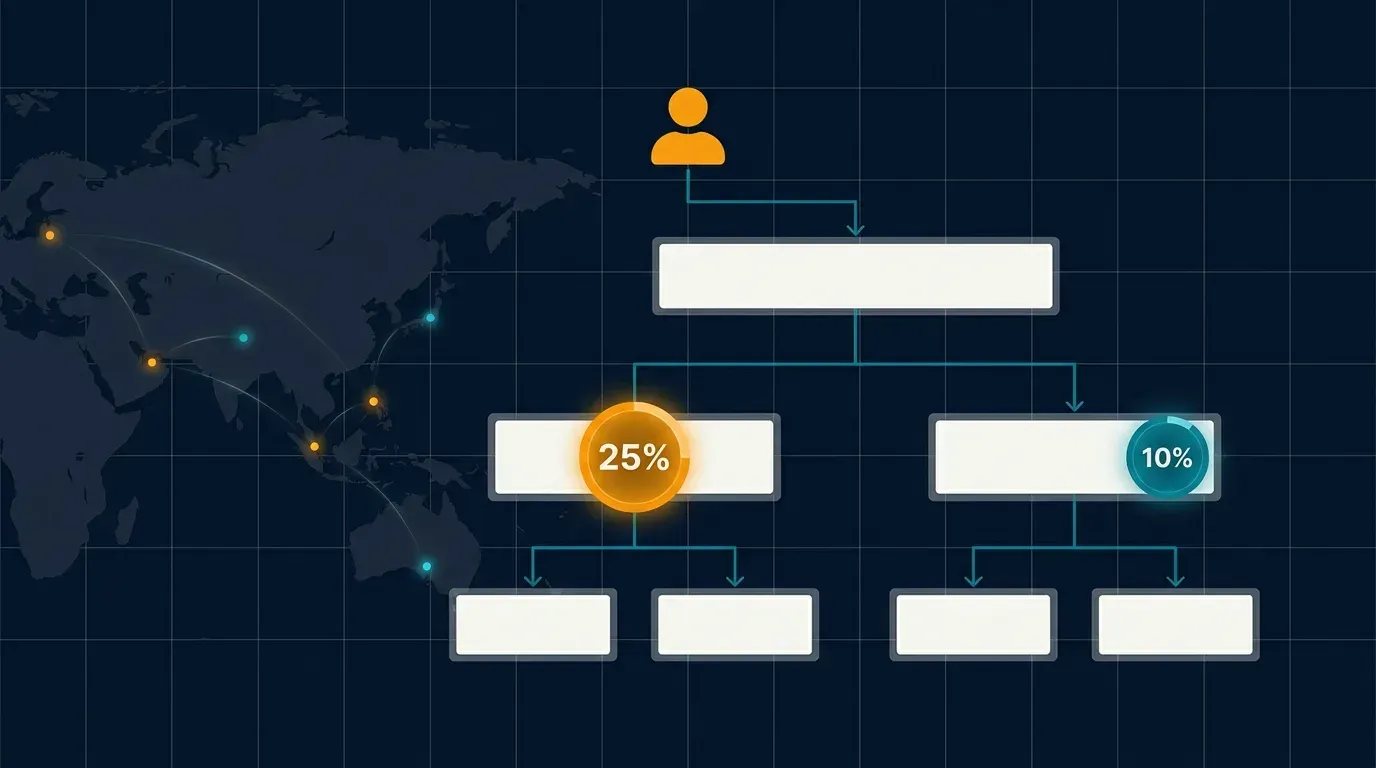
When a regulator asks who controls your company, they are not asking for the name of a holding entity. They want a natural person — a human being at the end of the ownership chain who ultimately benefits from or directs the business. That person is the ultimate beneficial owner (UBO), and identifying them correctly is a mandatory step in every regulated licensing process.
The question of who qualifies as a UBO is more nuanced than it appears. The 25% ownership threshold is widely cited, but it is only one test, and some regimes set it lower. Control can exist without significant shareholding, ownership chains can run through multiple jurisdictions, and different regulators interpret the rules differently. Getting this wrong has real consequences: delayed licence applications, failed due diligence, and in some cases, regulatory sanctions.
This article explains how UBO thresholds work, how to calculate indirect ownership, when the control test applies instead of the ownership test, and how the rules differ across the jurisdictions most relevant to crypto, iGaming, and forex operators.
What Is a UBO?
UBO stands for ultimate beneficial owner. An ultimate beneficial owner is the natural person who ultimately owns or controls a legal entity, whether that ownership or control runs directly or indirectly through a chain of other companies, trusts, or nominees.
Two features of this definition are essential to understand. First, a UBO must always be a natural person — a UBO can never be another company. The search continues up the ownership chain until it reaches a human being. Second, a UBO qualifies through ownership, such as holding shares, or through control, such as voting rights or the power to appoint directors, even without direct shareholding.
The Financial Action Task Force (FATF) defines a UBO as “the natural person(s) who ultimately owns or controls a customer and/or the natural person on whose behalf a transaction is being conducted,” and includes those persons who exercise ultimate effective control over a legal person or arrangement.
It is also worth distinguishing a UBO from a beneficial owner more broadly. A beneficial owner is anyone who owns or controls an entity or benefits from it. An ultimate beneficial owner is specifically the natural person at the very end of the ownership or control chain, once you have followed it through every intermediate company, trust, or nominee. The word ‘ultimate’ signals that the answer must resolve to a human, never to another company.
The 25% Threshold: Where It Comes From
Many jurisdictions use 25% as the ownership or voting-rights level that triggers UBO identification. The figure comes from FATF. The Interpretive Note to Recommendation 10 gives 25% as an example of a controlling ownership interest. FATF’s March 2023 guidance on Recommendation 24 treats 25% as a maximum, so countries may set a lower, risk-based threshold.
Under the current EU Anti-Money Laundering Directive (Directive (EU) 2015/849), a shareholding or ownership interest of more than 25%, held directly or indirectly, indicates beneficial ownership. Indirect ownership must be calculated through the full ownership chain.
However, the 25% figure is better understood as a ceiling than a fixed rule. Some countries set lower thresholds. India, for example, uses more than 10% for companies under its Prevention of Money-laundering (Maintenance of Records) Rules, as amended in 2023. Under the EU’s Anti-Money Laundering Regulation (AMLR), Regulation (EU) 2024/1624, the European Commission can set a lower threshold of up to 15% for categories of corporate entity it identifies as higher risk. The AMLR applies from 10 July 2027, and it also changes the standard threshold from “more than 25%” to “25% or more.” This might sound like a trivial tweak, but it could require obliged entities to identify additional UBOs in their existing client portfolios, because someone sitting at exactly 25% now qualifies where they previously did not.
The Ownership Test vs. the Control Test
UBO identification involves two separate tests, and both must be applied. Stopping at the first is a compliance error.
The ownership test asks whether a natural person directly or indirectly holds shares, voting rights, or capital interest above the regime’s threshold (25% or more in many regimes, more than 25% in others). This is the most commonly used route and the most straightforward to check.
The control test applies when the ownership threshold is not met, or alongside it when control is exercised through other means. Even without meeting the ownership threshold, a person qualifies as a UBO if they exercise dominant influence through other means, such as veto rights over significant decisions, the contractual right to appoint or remove directors, or control via shareholder agreements.
The control test matters significantly in practice. A person who fails the ownership test can still be a UBO through the control test. This matters because sophisticated bad actors deliberately keep their stakes just under the threshold and govern through side agreements instead.
Red flags that should prompt a control test analysis include:
- Dual-class or veto-right share structures
- Shareholder agreements granting board appointment rights
- Management contracts held by a person not on the cap table
- Trusts where the settlor or protector retains meaningful influence
- Nominee shareholders holding legal title on behalf of another person
In some situations, an individual may hold a company’s shares without deriving any actual benefits. A nominee shareholder might appear on the register but have no right to vote, receive dividends, or enjoy other share-related benefits. Such a nominee is not considered the UBO because they lack the substantive rights typically associated with beneficial ownership. The obligation is always to look through the nominee to the person behind it.
Calculating Indirect Ownership
When ownership runs through intermediate companies, the calculation requires multiplying percentages along each layer of the chain. The result is the person’s effective stake in the entity being assessed.
If person A owns 50% of company X, and company X owns 60% of company Y, then A’s indirect stake in Y is calculated by multiplying down the chain: 50% times 60% equals 30%, which clears a 25% threshold. This multiplication, applied at every level and then added across every separate chain that reaches the same person, is what the EU’s incoming rules make explicit as the accumulation method.
A practical worked example helps illustrate this:
- Company Alpha is 60% owned by Beta Holdings.
- Beta Holdings is 50% owned by an individual named Maria.
- To find Maria’s effective stake in Alpha, multiply the percentages along the chain: 60% multiplied by 50% equals 30%. Because 30% is above the 25% threshold, Maria is a UBO of Alpha Ltd and must be identified, verified, and screened.
The same logic applies when a chain passes through three or more layers. The usual arithmetic is straightforward: ownership multiplies through each layer. A natural person who owns 60% of Holding A, which owns 50% of Holding B, which owns 100% of the operating company, indirectly owns 30% of the operating company (60% × 50% × 100%).
It is also worth noting the intersection with sanctions frameworks. OFAC’s 50% Rule and equivalent rules in other regimes extend sanctions to entities that are owned 50% or more, directly or indirectly, by sanctioned persons. This threshold operates separately from the AML-based UBO identification threshold and can apply even where no individual holds 25% on their own.
When No UBO Can Be Identified: The Senior Managing Official Fallback
In some structures — widely held public companies, dispersed family trusts, or complex multi-layered groups — it may not be possible to identify a natural person who meets either the ownership or control test. If no natural person can be identified as the UBO through ownership tracing, the most senior managing official must be identified and their status documented.
This fallback carries important caveats. Where neither test identifies a natural person, many frameworks designate the senior managing official of the entity as the UBO of record. This is a fallback position, not a genuine ownership finding, and it signals to regulators that the ownership structure warrants closer scrutiny.
The senior managing official fallback is a last resort, not a substitute for proper identification. Skipping UBO identification because no 25% holder exists is one of the most common compliance failures. Regulators expect documented evidence of the steps taken before the fallback is invoked.
Thresholds by Jurisdiction
The table below summarises UBO ownership thresholds across the jurisdictions most relevant to regulated operators in crypto, iGaming, and forex.
| Jurisdiction / Framework | Standard UBO Threshold | Notes |
|---|---|---|
| FATF (global baseline) | 25% as a maximum | Treated as a ceiling; countries may apply lower thresholds |
| EU (AMLR, from July 2027) | 25% or more | The Commission may set a threshold of up to 15% for higher-risk categories of entity. Until then, the current AML Directive uses “more than 25%” |
| United Kingdom (PSC regime) | More than 25% | A person at exactly 25% does not qualify; phrasing differs from EU |
| United States (FinCEN CDD Rule) | 25% or more | Applies to banks and other covered institutions, and also requires one control person in every file. Separately, FinCEN’s August 2026 final rule (following its March 2025 interim rule) exempts US companies from Corporate Transparency Act BOI reporting; only foreign companies registered to do business in the US still file |
| UAE (Cabinet Decision No. 109 of 2023) | 25% or more | Covers mainland and commercial free-zone entities; the DIFC and ADGM financial free zones run their own beneficial-ownership rules |
| Singapore (ACRA register of registrable controllers) | More than 25% | ‘Registrable controllers’ under the Companies Act 1967, with a separate significant-control test. MAS-licensed firms also identify their customers’ beneficial owners under MAS AML/CFT notices |
| Hong Kong (Significant Controllers Register) | More than 25% | Companies Ordinance (Cap. 622); control tests include the right to appoint or remove most directors. The company keeps the register; it is not open to public search |
| Vietnam (Law on Enterprises as amended in 2025; Decree 168/2025/ND-CP) | 25% or more | Of charter capital or voting shares, directly or indirectly, plus a control test. In force since 1 July 2025 |
| India | More than 10% (companies) | PML (Maintenance of Records) Rules, lowered from 25% in 2023; partnerships and trusts also use 10% |
One wording difference has practical significance. The UK PSC test is ‘more than 25 percent’, while the incoming EU regime and the US use ’25 percent or more’. Hong Kong and Singapore’s controller registers also use “more than 25%”. A shareholder holding exactly 25% is a UBO under the AMLR, US and Vietnamese rules, but not under the UK PSC regime or the Hong Kong and Singapore registers. For cross-border structures, the distinction matters when determining registration obligations in each jurisdiction.
Japan also uses a unique two-tier threshold: if someone holds over 50% of voting rights, they are the sole UBO and anyone at the 25% level is excluded. This differs from most jurisdictions, where anyone above 25% qualifies regardless of whether a majority holder exists.
For founders based in Asia, the same structure is often tested against several of these rules at once. A Vietnamese or Chinese founder who holds a licensed entity through a Hong Kong or Singapore holding company may need to appear on that holding company’s controller register, in the licensing regulator’s fit-and-proper file, and in each bank’s UBO declaration. The thresholds and wording differ, so map the chain once and check it against each regime. Do not assume one 25% answer works everywhere.
UBO in Regulated Industries: Crypto, iGaming, and Forex
UBO identification requirements apply with particular rigour across the regulated sectors that GSS Legal serves. Licence applications for crypto/VASP, iGaming, and forex businesses require UBO documentation as a core submission element, and regulators will not issue a licence until all beneficial owners are identified, verified, and assessed for fit-and-proper status.
Crypto and VASP licensing: Directors and ultimate beneficial owners (UBOs) are subject to background checks, criminal record requirements, and in many jurisdictions, a formal fit-and-proper declaration. UBO declarations form part of the licence application package alongside AML/KYC policies, business plans, and corporate structure diagrams. Under MiCA, the EU’s crypto-asset regulation, CASP licence applicants must identify shareholders and members with qualifying holdings, direct or indirect, and show the national competent authority that they are of sufficiently good repute.
iGaming licensing: iGaming regulators — including those in Curaçao, Malta, and Gibraltar — apply UBO scrutiny as part of their suitability assessments. For operators holding or applying for an iGaming licence, any change in UBO status after the licence is granted typically requires regulator notification and, in many cases, prior approval. Undisclosed changes to UBO can result in licence suspension.
Forex and FX licensing: Firms operating under forex licences from regulators such as the FCA, Labuan FSA, or the DFSA face ongoing UBO disclosure obligations. Brokers structured through holding companies in multiple jurisdictions must map their entire ownership chain before applying. An individual who controls a majority-owned intermediate company may be treated as a UBO of the operating company, depending on the stake that intermediate holds and how the regulator treats control through a chain.
Across all three sectors, AML-obliged entities dealing in securities, currency exchange, forex, binary options, casinos, blockchains, and related activities are required to establish and monitor the UBOs of their company-clients. This applies both when a regulated firm is licensing its own entity and when it is onboarding corporate clients.
The AML and compliance framework underpinning a licence application must address how UBOs will be identified, verified, and monitored on an ongoing basis. Regulators reviewing applications check not only who the UBOs are, but whether the applicant has a credible process for keeping that information current.
Common Mistakes in UBO Identification
Errors in UBO identification are a common deficiency in regulatory inspections and licence assessments. The most common ones are:
- Stopping at the first legal owner. Identifying a holding company as the owner and not tracing through it to the natural person behind it.
- Treating 25% as an exemption threshold. Concluding that no UBO exists because no shareholder crosses 25%, without applying the control test or the senior managing official fallback.
- Accepting customer-declared structures without verification. Relying solely on customer-provided structures — accepting the customer’s declared organogram without independent verification against registries or supporting documentation.
- Treating UBO records as static. Verifying UBO at onboarding and never refreshing. Ownership changes; the verification must be refreshed periodically and triggered by material events.
- Failing to screen identified UBOs. Verifying UBO identity but omitting sanctions and PEP screening of the verified UBOs. The screening obligation extends to UBOs in full.
- Not documenting the process. Even when UBO identification is correctly performed, failing to document the steps taken and the rationale for conclusions reached creates an audit gap.
What UBO Verification Actually Involves
Identification and verification are two distinct obligations. Identifying a UBO means establishing who they are. Verifying means confirming that the identification is accurate through independent sources.
A UBO declaration typically captures each owner’s full name, date and country of birth, nationality, country of residence, the percentage held, and the nature of the ownership or control. This declaration is a starting point, not proof.
Under FATF guidance and EU rules, a firm cannot simply accept the declaration. It must take reasonable measures to check the named people against independent sources, increasing the intensity as risk rises. Verification typically involves cross-referencing against company registries, official identification documents, and beneficial ownership registers where available.
Once verified, UBOs must also be screened. Firms must verify the identity of all UBOs through document verification and proof of address, and cross-reference UBOs against sanctions databases, Politically Exposed Persons (PEP) lists, and adverse media checks to detect any red flags.
For high-risk structures or individuals, enhanced due diligence applies. For high-risk individuals or complex ownership structures, enhanced due diligence may involve comprehensive research, engaging third-party providers, or utilising automation tools to gather in-depth UBO information.
Ongoing monitoring is also mandatory, not optional. At minimum, re-screening should occur on trigger events: ownership change, new sanctions or adverse-media hits, jurisdiction change, or significant transaction-volume increase. Periodic rescreening — often annually for lower-risk customers — is standard under most customer due diligence programmes.
For operators navigating multi-jurisdiction corporate structures — a common scenario for businesses holding VASP licences, CASP licences, or forex licences across more than one market — mapping the full UBO picture before submission is a critical step. Regulators across EU, UAE, Singapore, and offshore jurisdictions all require this analysis to be completed upfront, and inconsistencies between what is declared and what registries show are a common cause of application delays.
Key Takeaways
The 25% ownership threshold is the most widely recognised trigger for UBO identification, but it is not the whole picture. A person can qualify as a UBO through the control test without holding any shares at all. Thresholds differ by jurisdiction — sometimes in wording, sometimes in percentage — and sectors classified as high-risk can face lower benchmarks. The EU’s shift from “more than 25%” to “25% or more” under the AMLR, taking effect in July 2027, will require many firms to revisit their existing UBO records.
For founders, compliance officers, and legal counsel working on a licence application, the practical implication is straightforward: map the full ownership chain before you approach the regulator, apply both the ownership and the control test, verify what you find against independent sources, and build a process to keep the picture current. A UBO declaration that does not hold up under scrutiny is not just a compliance gap — it is a reason for a regulator to pause or reject an application.
Across the regimes GSS Legal works with — from UAE VARA and Lithuania’s CASP regime to Curaçao — UBO documentation is part of every licence submission. Getting it right at the outset shortens review timelines and avoids the information requests that cause delays. See our AML and compliance services and jurisdiction advisory for further guidance on how these requirements apply to your specific structure.
Need to map your UBO structure before a licence application?
GSS Legal has supported over 800 licence applications across 50+ jurisdictions. We work through UBO mapping, ownership documentation, and AML programme design as part of the application process — not as an afterthought. Whether you are preparing for a VASP or CASP licence, an iGaming licence, or a forex licence, structuring your ownership correctly from the start matters.
Reach us on WhatsApp, Telegram, WeChat or Zalo (+84 909 687 311), or book a consultation.